What pages does a local business website actually need?
Find out which pages a local business website needs to improve local SEO, build trust and turn more visitors into real enquiries.
In short
Most local business websites need a clear homepage, individual service pages, a contact page with your area, an about page that feels real, visible reviews, and useful FAQs. The quality of those pages matters more than the quantity.
Most local business websites do not fail because they are missing clever features.
They fail because the important pages are vague, thin, hidden, duplicated, or written in a way that makes the business sound like every other business in the area. If that sounds familiar, here is why your website might be losing you enquiries and what to do about it.
That matters because people rarely enquire from a website just because it exists. They enquire when the site makes the business feel clear, credible and easy to contact.
For a local business, your website is not just a brochure. It is part sales tool, part trust signal, part search asset and part enquiry filter. The right pages do not just help you show up in Google. They help the right people decide whether you are the right business to contact.
The homepage still matters
It is easy to underestimate the homepage because SEO conversations often focus on service pages, location pages and blog content.
But for most local businesses, the homepage is still the front door.
It is often the most visited page on the site. It is often the page people land on after seeing your van, your Google Business Profile, your social media, a local recommendation or your name in a WhatsApp group. It is also one of the pages search engines use to understand your business at a broad level.
A strong local business homepage should answer three questions quickly:
- Who do you help?
- What do you do?
- How can someone take the next step?
That sounds simple, but many local sites miss it.
They open with vague lines like "quality service you can trust" or "your local experts", without saying what the business actually does or where it operates. Which is a problem, because every business seems to be a trusted local expert when nobody is being specific.
A better homepage makes the offer obvious. For example:
"Reliable garden maintenance for homeowners in Cheltenham and the surrounding Cotswolds."
That one line tells the reader the service, audience and location. It also gives search engines clearer context.
Your homepage should include:
- A clear description of your main services.
- The main locations or service areas you cover.
- Trust signals, such as reviews, accreditations, years of experience or examples of work.
- A short explanation of what makes you different.
- Clear calls to action.
- Links to your main service pages.
- Real photos where possible.
The homepage does not need to say everything. It needs to make the rest of the site easier to understand.
Service pages do the commercial heavy lifting
For local SEO, service pages are some of the most important pages on your website.
If someone searches for "emergency plumber near me", "wedding florist Cheltenham", "garden clearance Gloucester" or "accountant for small businesses in Worcester", they are not looking for a general homepage.
They are looking for a specific service.
That is why individual service pages matter.
A general "Services" page listing everything you do is rarely enough. It can be useful as a summary page, but it should link through to more detailed pages for each core service.
For example, a landscaping business might need separate pages for:
- Garden design.
- Patio installation.
- Fencing.
- Turfing.
- Decking.
- Garden maintenance.
Each page should be written around the specific job the customer needs doing. Not just for search, but for conversion.
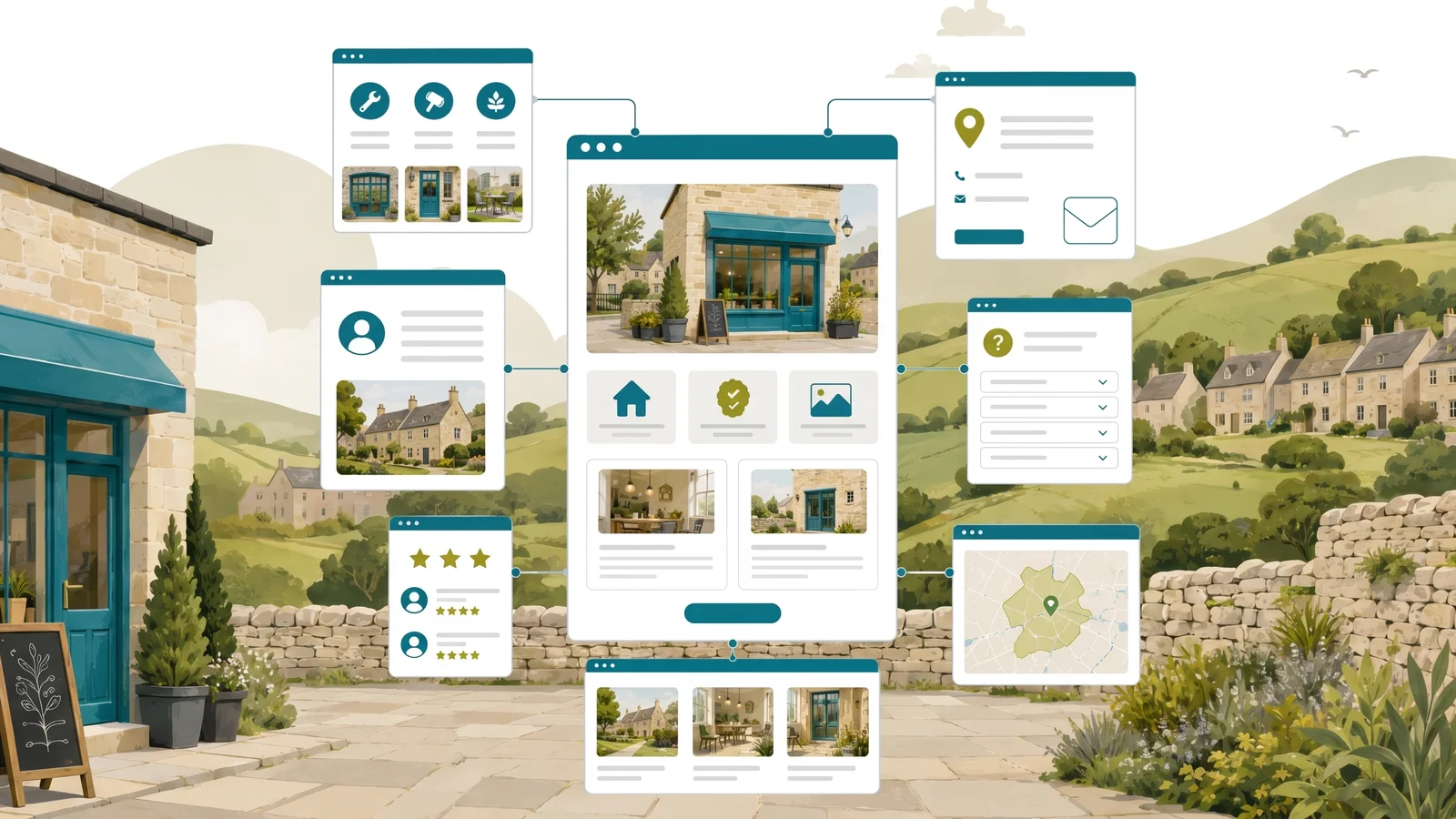
A good service page should explain:
- What the service includes.
- Who it is suitable for.
- Common problems the customer may be facing.
- What the process looks like.
- Why your business is a safe choice.
- Relevant examples, reviews or photos.
- The areas where the service is available.
- How to enquire.
The mistake is creating dozens of near-identical service pages with the name of the service swapped out. That does not build trust. It also does not help the page stand out.
Every important service page should feel like it was written for someone genuinely considering that service.
Contact and location pages are more important than they look
The contact page is often treated as an afterthought.
A form. A phone number. Maybe an email address.
Done.
But for a local business, the contact or location page plays a bigger role. It helps customers understand whether you are real, reachable and relevant to them. It also helps keep your website aligned with your Google Business Profile and other local listings.
A useful contact page should include:
- Business name.
- Address, if relevant.
- Phone number.
- Email address or contact form.
- Opening hours.
- Areas served.
- Embedded map, if you have a physical location.
- Clear directions or parking information, where helpful.
For service-area businesses, the address may not always be public or customer-facing. In that case, the page should still make your coverage clear.
For example:
"Based near Tewkesbury, we work with homeowners and small businesses across Cheltenham, Gloucester, Worcester and the wider Cotswolds."
That gives people confidence. It also helps avoid wasted enquiries from customers outside your area.
The contact page is not just an admin page. It is a trust page.
The About page should prove there is a real business behind the website
The About page is one of the most underused pages on local business websites.
Too often, it sounds like this:
"We are a passionate team committed to delivering high-quality solutions with excellent customer service."
That could be anyone.
A strong About page should make the business feel real. It should answer questions people are often quietly asking:
- Who are you?
- Why did you start the business?
- How long have you been doing this?
- Are you local?
- Can I trust you in my home, business, venue or project?
- What do you care about?
- What kind of customers do you work best with?
For local businesses, real detail matters.
A photo of the person turning up at the door, the workshop where the work happens, the van people might see locally, or the team behind the service can do more for trust than another polished paragraph about "excellence".
The About page does not need to be overly personal, but it should not be sterile either. People often choose local businesses because they want someone accountable, approachable and human.
Your About page should give them that.
Reviews and testimonials deserve proper visibility
Reviews influence local decisions.
That does not mean every business needs a huge standalone reviews page, but reviews should not be hidden away either.
At minimum, strong testimonials should appear across:
- The homepage.
- Key service pages.
- Contact or enquiry pages.
- Relevant case studies or project pages.
A dedicated reviews or testimonials page can also work well, especially if you have lots of customer feedback and want somewhere to send people before they enquire.
The best testimonials are specific. They mention the service, the problem, the result, the location or the experience of working with you.
For example, this is more useful:
"Chris repaired our leaking flat roof in Cheltenham within two days of our enquiry. He explained the issue clearly, gave us photos before and after, and left everything tidy."
Than this:
"Great service. Highly recommend."
Both are positive, but only one gives a future customer useful context.
FAQs are useful when they answer real questions
FAQ pages can be helpful, but only when they are based on genuine customer questions.
Many FAQ sections are written for search engines first and customers second. That is where they go wrong.
Good FAQs should come from:
- Sales calls.
- Email enquiries.
- Google Business Profile questions.
- Customer objections.
- Common points of confusion.
- Things people ask before committing.
For example:
- How quickly can you visit?
- Do you charge for quotes?
- What areas do you cover?
- Are you insured?
- Do I need to be home?
- Do you work with landlords?
- Can you handle urgent jobs?
- Can you provide photos of previous work?
You can have a standalone FAQ page, but it is often better to include service-specific FAQs on relevant service pages as well.
A general FAQ page can answer broad questions about the business. Service pages can answer questions about that specific service.
That is more useful for visitors and clearer for search.
Service-area pages can work, but only when they are real
Service-area pages are common in local SEO.
They are also commonly done badly.
The idea is simple. If your business serves multiple towns, villages or counties, you may create pages for those areas.
For example:
- Plumber in Cheltenham.
- Plumber in Gloucester.
- Plumber in Tewkesbury.
- Plumber in Worcester.
The problem comes when each page is almost identical, with only the town name changed.
That kind of page rarely helps anyone. It feels lazy to users and thin to search engines.
A useful service-area page should include genuine local relevance.
That might include:
- The specific services available in that area.
- Photos from work completed nearby.
- Reviews from customers in that area.
- Local landmarks, neighbourhoods or common property types where relevant.
- Travel or availability notes.
- Clear links to the most relevant service pages.
- A reason why the page exists beyond trying to rank.
If you cannot make a location page genuinely useful, it may not deserve to exist.
For many smaller local businesses, it is better to have a strong core website with clear service-area information than dozens of weak town pages.
Project, case study or gallery pages help customers believe the claim
For many local businesses, especially trades, home improvement companies, venues, creatives and professional services, proof matters.
A project page or case study page can show the kind of work you actually do.
This does not need to be complicated.
A good project page can include:
- The customer problem.
- The location.
- The service provided.
- Before and after photos, where relevant.
- A short explanation of the work.
- Any challenges solved.
- A customer quote.
- A clear next step.
These pages help with trust, but they can also support search. They create more specific content around real services, real places and real problems.
They are also useful sales assets. If someone asks, "Have you done anything like this before?", you have something to send them.
Legal and policy pages still matter
Legal and policy pages will not usually win you new enquiries on their own. They do, however, help your website feel complete, responsible and legitimate.
If you collect personal information through forms, analytics, newsletter sign-ups or booking tools, make sure the basics are in place. That usually means a privacy policy, cookie information and terms where relevant.
These pages are not the main event, but their absence can make a small business website feel unfinished.
The pages are only part of the job
Having the right pages is the starting point.
The quality of those pages is what makes the difference.
A local business website should not be built as a pile of disconnected pages. It should work as a clear system.
The homepage explains the business.
The service pages explain what you do.
The location or contact page confirms where you are and how to reach you.
The About page builds confidence.
The reviews and case studies prove the experience.
The FAQs remove friction.
The service-area pages clarify where you work.
The navigation and internal links help people move through the site.
When those pieces work together, the site becomes easier for customers, Google, Google Maps and AI search systems to understand.
That matters because local visibility is not just about keywords. It is about clarity, consistency and trust.
The real question is not "how many pages do I need?"
A better question is:
What does a potential customer need to see before they feel confident enough to enquire?
For some businesses, that might be a small but well-structured site with five or six strong pages.
For others, it might mean individual service pages, multiple location pages, case studies, FAQs and a deeper content structure.
The right answer depends on the business. What a barber needs is genuinely different from what a builder needs: a barber lives or dies on prices and opening hours, while a builder is judged on their portfolio and their accreditations. We have written up what the pages actually look like for barbers, hair salons, builders, plumbers, dog groomers and florists.
But the principle is the same.
Do not create pages just to fill a sitemap.
Create pages that help people make a decision.
Because the best local business websites do more than rank.
They explain clearly, build trust quickly and make it easy for the right people to take action.
If you are still deciding how to build your site, this comparison of Wix and Squarespace looks at the real cost of the DIY route for local businesses.
Need help getting your website structure right?
If your website is missing some of these pages, or the ones you have are not doing the job properly, we can help you get the structure, copy and foundations in place. Just £450 one-off build + £15/mo hosting.
Get startedFrequently asked questions
There is no fixed number. Some businesses need five or six strong pages. Others need individual service pages, location pages, case studies and FAQs. The right answer depends on how many services you offer, how many areas you cover, and how much detail your customers need before they feel confident enough to enquire.
In most cases, yes. Individual service pages give Google something specific to index and give potential customers the detail they need to make a decision. A single page listing all your services is rarely enough to rank or convert well.
Only if you can make them genuinely useful. Pages that simply swap a town name into identical copy rarely help. A good location page includes real local detail, photos from work in the area, reviews from local customers, and clear service information.
The homepage is usually the most visited page and the first impression for many visitors. But service pages often do the most commercial heavy lifting because they match what people are actually searching for.