Rated
Companies House identity verification: how the deadline works for small business directors
Existing company directors are coming to the end of their transition year for Companies House identity checks, but there is no single deadline for everyone. A plain-English guide for small limited companies: where you stand, the separate step for owners, how to verify for free, scam emails to ignore, and what your website must show.


In short
Since 18th November 2025, identity verification has been a legal requirement for company directors in the UK. Directors already in post were given a transition year, and there is no single deadline for all of them: Companies House asks existing directors to give their personal code as part of their company's next confirmation statement, and says a company cannot file its confirmation statement unless all its directors are verified. If yours has been filed since 18th November 2025, the director check should be done. But if you also own the company, you are probably a person with significant control too, which is a separate step with its own deadline. Verifying directly through GOV.UK One Login is free. While you are at it, check your website shows the details the law requires, such as your company's registered name, number, where it is registered and its registered office.
Does your website show your company details? We'll check it for free
A limited company's website must show its registered name, company number, where it is registered and its registered office, and most business websites also need the business's name, a contact email and an address. Our free website check tells you if anything is missing.
Get a free website checkIf you run your business as a limited company, you have probably had emails, letters or a nudge from your accountant about Companies House identity checks. A lot of the coverage talks about one deadline for everyone in November 2026. It is not that simple: where you stand depends on when your company's confirmation statement is due, and whether you also own the company.
This guide is written for small limited companies: the sole director, the family firm with a husband, wife or partner as a second director, and the local business that has an accountant file everything once a year. It explains how the deadline works, the separate step most owners need to take, how to verify for free, which scam emails to ignore, and something many small businesses get wrong: what your website must show.
This is general information to help you understand the changes, not legal advice. Companies House guidance is updated from time to time, so check the latest on GOV.UK, and speak to your accountant or Companies House about your own company. We last checked the sources below on 5th November 2026.
What's changing
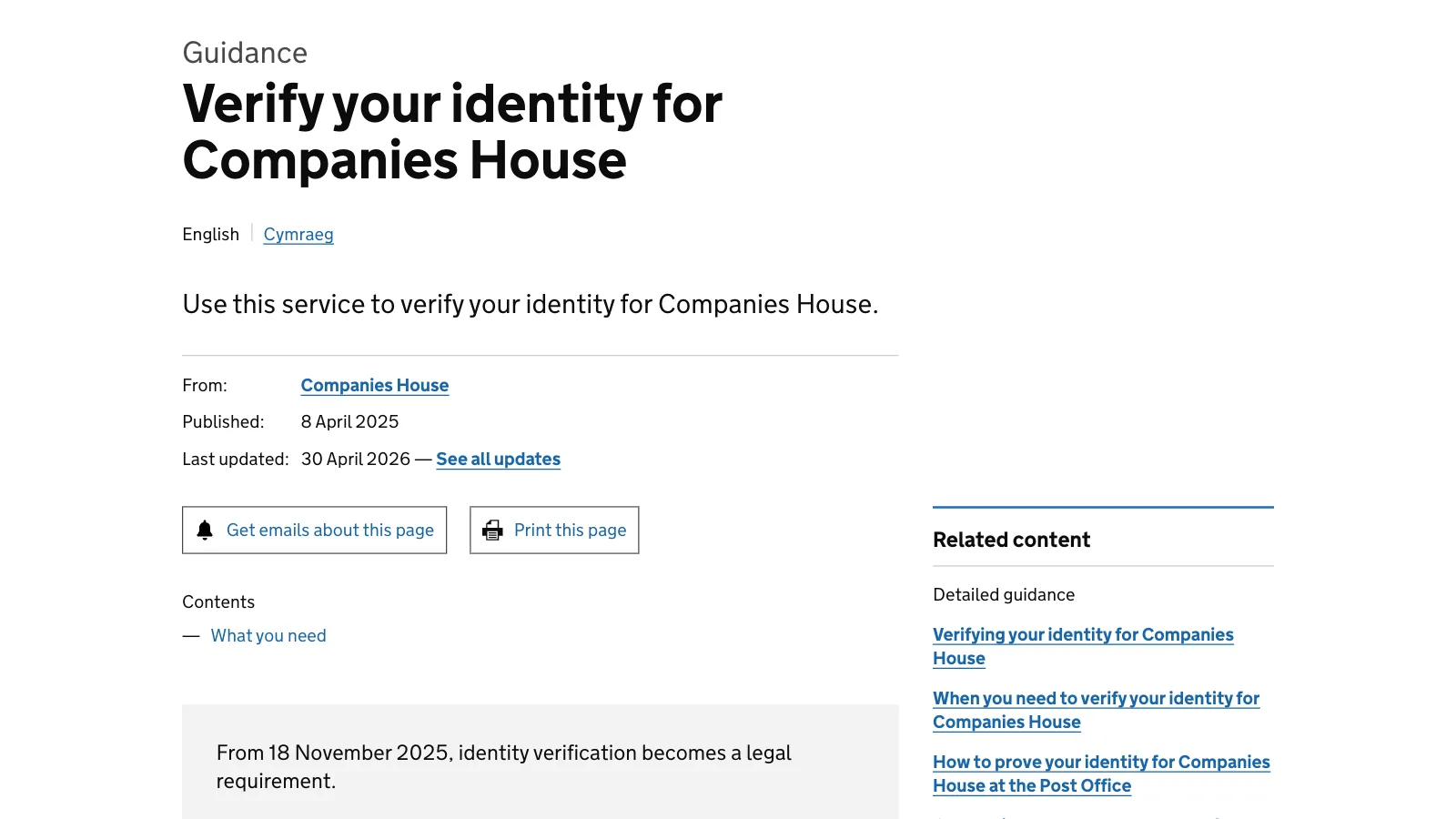
Since 18th November 2025, anyone who becomes a company director, an LLP member or a person with significant control (PSC) has had to verify their identity with Companies House first. It comes from the Economic Crime and Corporate Transparency Act 2023, and the aim is to make it harder for people to set up companies under false names.
Directors and PSCs who were already in place on 18th November 2025 were given a transition year to verify. Companies House's latest plan, updated on 23rd October 2026, says it expects to complete the transition by the end of 2026 at the earliest, and then to take action against people who have not verified.
By 30th September 2026, 78% of director appointments on the register had been verified, according to Companies House management information. That still leaves about one in five, and the figure counts appointments rather than people, so someone who is a director of three companies is counted three times.
Who needs to verify in a small business
In a typical small limited company, that means:
- You, as a director. If you are the only director, it is just you.
- Any other director, often a husband, wife or business partner who was added when the company was set up. They need to verify too, even if they are not involved day to day.
- Anyone with significant control of the company. That usually means owning more than 25% of the shares or votes, but it also includes anyone who can appoint or remove most of the directors, or otherwise has significant control. Companies House calls them people with significant control (PSCs).
If you are a director and you also own the company, you are probably both. That matters, because Companies House says you give your personal code separately for each role. More on that below.
If you are a sole trader and do not have a limited company, these checks do not apply to you.
How the deadline works for existing directors
For directors who were in post before 18th November 2025, there is no single date. Companies House says 18th November 2025 "is not a deadline", and asks existing directors to give their personal code as part of their company's next confirmation statement: the yearly filing that confirms your company's details are up to date, which your accountant may do for you.
Companies House also says a company cannot file its confirmation statement unless all its directors are verified. In practice, that gives you a simple way to check the director part:
- If your confirmation statement has been filed since 18th November 2025, your directors should have been verified as part of it. That covers the director role only. If someone else files it, such as your accountant, ask them to confirm.
- If your confirmation statement is due soon, or is overdue, verify now, so it can be filed on time.
- If you are a director of more than one company, you verify once, then give your personal code for each company.
Not sure when your confirmation statement is due? Search for your company on Companies House's free Find and update company information service. The company page shows when the next one is due.
The separate step if you also own the company
If you are a director and also a person with significant control, the PSC step is separate. Companies House says existing directors who are also PSCs give their personal code through its PSC service, within 14 days starting the day after the company's confirmation statement date. You can ask for a 14-day extension, as long as you ask before the deadline.
People with significant control who are not directors follow a different timetable: Companies House says they verify within the first 14 days of their birth month during the transition year. Its guidance on when you need to verify sets out each case.
How to verify your identity, for free
Companies House says verifying directly through GOV.UK One Login is free. The main ways to do it are:
- The GOV.UK One Login app on your phone, using photo ID. Companies House says this can usually be done in minutes.
- In person at a Post Office. You enter your photo ID details on GOV.UK first, and not every branch offers the service.
- Without photo ID, if you live in the UK: the service may let you verify using your bank or building society details, your National Insurance number and some security questions.
Companies House currently lists these forms of photo ID: a biometric passport from any country, a UK photo driving licence (full or provisional), a UK biometric residence permit or card, or a UK Frontier Worker permit. You cannot use an expired passport, and other expired documents are only accepted in limited cases. Check the current list on GOV.UK before you start.
You can also verify through an Authorised Corporate Service Provider, such as an accountant, solicitor or formation agent registered with Companies House. Some small business owners find that easier, but they may charge for it.
What is the Companies House personal code?
Once you are verified, you get a Companies House personal code. It belongs to you, not your company, so you use the same code for every company and every role you hold. You give it when your company files its confirmation statement, when you are appointed as a director, when a company is set up, and as a person with significant control. Keep it somewhere safe, and only give it to people you trust to file for you, such as your accountant.
What happens if you don't verify
According to Companies House:
- Your company cannot file its confirmation statement until all its directors are verified. If that stops it being filed on time, it is late, and filing late is an offence for the company and its officers.
- Acting as a director without being verified, once you are required to be, is a separate offence for the director and for the company.
- People with significant control who do not verify may also be committing an offence.
- Companies House may use financial penalties, notes on the public register, removing companies from the register and, in serious cases, prosecution. Its plan is to take action once the transition has ended.
If anything is unclear for your own company, speak to your accountant or Companies House before your confirmation statement is due.
Watch out for scam emails
Deadlines like this bring a wave of fake emails, and Companies House has published warnings about them. It describes fake "verify your identity" emails, some demanding you act within 24 hours, sent from look-alike addresses rather than official ones.
- Real Companies House emails come from addresses ending in .gov.uk, and it does send genuine reminders. But do not click links in any email: go to GOV.UK yourself and start from there.
- Companies House says it will never call you to ask for secure information such as passwords, bank details or authentication codes.
- Forward suspicious emails to phishing@companieshouse.gov.uk, and see Companies House's scam guidance for how to report calls and letters.
In our experience, small businesses are also targeted with fake invoices for domain renewals and "directory listings". If an email asks for money or a code, check it independently before you do anything.
Sole traders: these checks are for companies
Sole traders and ordinary partnerships are not registered at Companies House, so these identity checks are for company directors, LLP members and people with significant control. If you work as a sole trader but are also a director or a person with significant control of a limited company, the company side does apply. The website rules in the next section are worth a look whichever you are.
While you're at it: what your company website must show
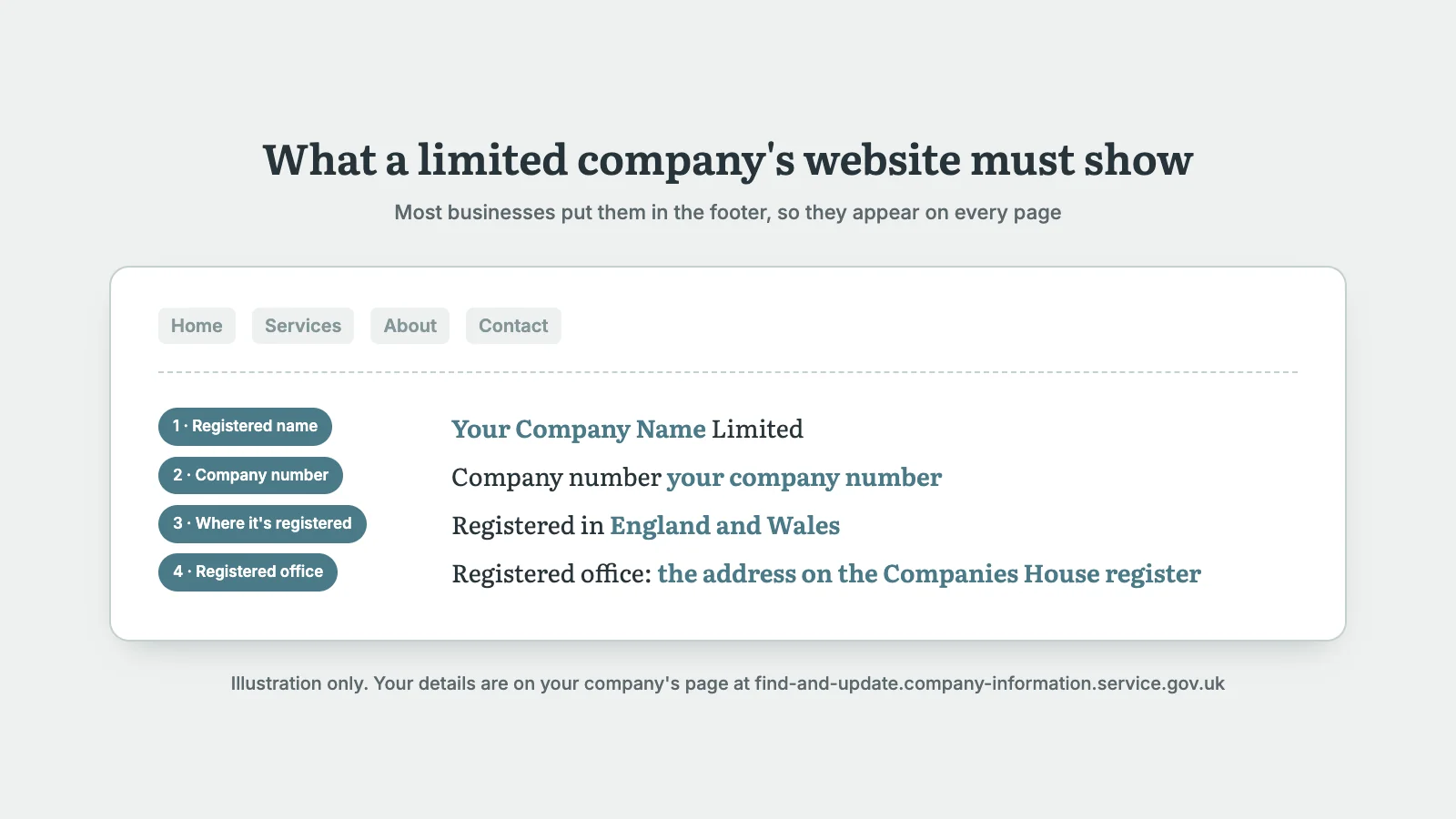
This is the part many small businesses miss, and it is not new. Under the trading disclosure rules, a UK limited company's website must show at least:
- Its registered name, as it appears at Companies House
- Its registered company number
- The part of the UK it is registered in, such as England and Wales, Scotland or Northern Ireland
- Its registered office address
Separately, the Electronic Commerce Regulations 2002 mean most business websites, including those of sole traders, should show the business's name, a contact email address and a geographic address, plus your VAT number if you are VAT-registered, and some extra details if you belong to a regulated profession.
Your registered name must also appear on all business correspondence, including emails. The company number, place of registration and registered office are required on business letters and order forms, and it is sensible to add them to your email signature too. Not complying is an offence that can lead to a fine. Just as importantly for a small business, customers and other firms can look you up, and a missing company number on a website can make a business look less established than it is.
Two related things are worth checking while you are looking at your company details:
- Your registered office must be an "appropriate address", where post will reach someone and delivery can be acknowledged, not a PO box. That rule came in on 4th March 2024, along with a requirement to give Companies House a registered email address.
- Your domain name should be registered to your company or to you, not to a former web designer. Our free security check shows when your domain is due for renewal.
If your website is missing any of these details, it is usually a quick fix. Ask for a free website check and we will tell you what is missing. If we built your website, or look after it on one of our monthly care plans, this is the kind of small change those plans include.
Also coming: accounts filed through software
One more change to have on your radar. Companies House has announced that from April 2028, company accounts will need to be filed using commercial software, rather than through its website or on paper. The government will continue to allow companies to file abridged accounts, and has paused plans to make small and micro companies file a profit and loss account. If your accountant files for you, it is worth asking how they will handle it, and whether any software costs will be passed on.
What to do now
- Check your confirmation statement date on Companies House's free register. If it has been filed since 18th November 2025, the director check should be done; if it is due soon or overdue, verify now.
- If you also own the company, check whether you have done the separate step as a person with significant control.
- Verify for free through GOV.UK if you have not already, and give your personal code to whoever files your confirmation statement.
- Ignore links in emails about this. Real Companies House emails come from addresses ending in .gov.uk, but start from GOV.UK yourself either way.
- Look at your website footer. If your company name, number, place of registration, registered office, contact email and geographic address are not there, that is an easy fix, and we can check it for you.
This article is general information, not legal advice. For anything specific to your company, speak to your accountant or Companies House.
Sources
- Verify your identity for Companies House, Companies House, updated 30th April 2026
- When you need to verify your identity for Companies House, Companies House, updated 30th July 2026
- Verifying your identity for Companies House, Companies House
- Economic Crime and Corporate Transparency Act: outline transition plan for Companies House, Companies House, updated 23rd October 2026
- Making identity verification simple, secure and trusted, Companies House blog, 16th October 2025
- Understanding identity verification for people with significant control, Companies House blog, 16th January 2026
- Companies House approach to non-compliance with mandatory identity verification, Companies House
- Identity verification management information, July to September 2026, Companies House, 29th October 2026
- Reporting scams pretending to be from Companies House, Companies House, updated 16th July 2026
- Companies Act 2006, section 167M, on acting as an unverified director
- The Company, Limited Liability Partnership and Business (Names and Trading Disclosures) Regulations 2015, Part 6, on what company websites must show
- The Electronic Commerce (EC Directive) Regulations 2002, regulation 6, on the information business websites must provide
- Companies House update to accounts filing from April 2028, Companies House, 23rd October 2026
Want a second pair of eyes on your website?
Send me your website address and I'll check it for free: whether your company details are there, whether it is secure and up to date, and anything else worth fixing. I'll give you a clear answer with no obligation.
Check my websiteFrequently asked questions
Since 18th November 2025, company directors, LLP members and people with significant control (PSCs) have had to prove who they are to Companies House. It was introduced by the Economic Crime and Corporate Transparency Act 2023. You verify once and get a Companies House personal code, which you then give for each role you hold in each company.
There is no single date for everyone. Companies House asks directors who were in post before 18th November 2025 to give their personal code as part of their company's next confirmation statement during the transition year, so the timing depends on your company's own confirmation statement date. Companies House says a company cannot file its confirmation statement unless all its directors are verified. Its latest plan says it expects to complete the transition by the end of 2026 at the earliest, and then take action against people who have not verified. If you are not sure where you stand, check with whoever files your confirmation statement, or with Companies House.
Probably, yes. If you own more than 25% of the shares or votes, or otherwise control the company, you are also a person with significant control (PSC), and Companies House says you must give your personal code separately for each role. For an existing director who is also a PSC, the PSC step is done through Companies House's PSC service, within 14 days starting the day after your company's confirmation statement date. You can ask for a 14-day extension before the deadline.
It is the code you get once you have verified your identity. Companies House says it is personal to you, not your company, so you use the same code for each company and each role. You give it when your company files its confirmation statement, when you are appointed as a director, when a company is set up, and as a person with significant control.
Companies House says verifying directly through GOV.UK One Login is free. You can use the GOV.UK One Login app on your phone with photo ID, or go to a Post Office that offers the service. If you live in the UK and do not have suitable photo ID, the service may let you verify using your bank or building society details, your National Insurance number and some security questions. You can also verify through an Authorised Corporate Service Provider, such as an accountant, who may charge a fee.
Companies House currently lists a biometric passport from any country, a UK photo driving licence (full or provisional), a UK biometric residence permit or card, or a UK Frontier Worker permit. You cannot use an expired passport, and other expired documents are only accepted in limited cases. Check the current list on GOV.UK before you start, as it can change.
Companies House says a company cannot file its confirmation statement unless all its directors are verified, and if that stops it being filed on time, it is late, and filing late is an offence for the company and its officers. Acting as a director without being verified, once you are required to be, is a separate offence under the Companies Act 2006. Companies House says it may use financial penalties, notes on the public register, removing companies from the register and, in serious cases, prosecution. People with significant control who do not verify may also be committing an offence. For your own situation, speak to your accountant or Companies House.
Sole traders and ordinary partnerships are not registered at Companies House, so these checks are for company directors, LLP members and people with significant control. If you are a sole trader but also a director or a person with significant control of a limited company, the company side does apply to you.
It might be, but be careful. Companies House sends genuine reminders from addresses ending in .gov.uk, and it also warns about fake 'verify your identity' emails from look-alike addresses, some demanding action within 24 hours. It says it will never call you to ask for secure information such as passwords, bank details or authentication codes. Either way, do not click links in the email: go to GOV.UK yourself, and forward suspicious emails to phishing@companieshouse.gov.uk.
If your accountant is registered with Companies House as an Authorised Corporate Service Provider, they can verify you, and they may charge for it. Verifying yourself through GOV.UK One Login is free.
A UK limited company's website must show at least its registered name, its registered company number, the part of the UK it is registered in (for example England and Wales), and its registered office address. Separately, most business websites, including those of sole traders, need to show the business's name, a contact email address and a geographic address, plus a VAT number if the business is VAT-registered. Your registered name must appear on all business correspondence, including emails. The company number, place of registration and registered office are required on business letters and order forms, and it is sensible to add them to your email signature too.