Rated
What should a dog walking or dog grooming website include?
What owners want to see before they trust you with their dog, the pages you actually need, and the simplest ways to set up a dog walking or grooming website.

In short
A dog walking or grooming website needs to answer what a careful owner wants to know: who you are, where you work, what you charge, why they can trust you and how to get in touch. For most people a few well-written pages are enough. Clear areas, real photos, reviews and insurance details do more than clever design.
People don't choose a dog walker or dog groomer the way they choose a takeaway. They are handing over a family member, and sometimes a house key too. Even when a friend gave them your name, most will look you up first.
So your website has one main job: to answer what a careful owner wants to know, quickly, on a phone.
Do dog walkers and dog groomers need a website?
Not on your first day. A Google Business Profile, a Facebook page and word of mouth can fill a diary.
A website starts to earn its place when any of these are true:
- You want more customers than recommendations are bringing in.
- You keep answering the same questions about prices and areas.
- You rely on an app or directory and want customers who book you directly.
- People are finding competitors because there's nothing about you to find.
If your diary is full and you're happy, you may not need one yet.
What every dog walking or grooming website needs
A clear first screen. What you do and where, in plain words: "Dog grooming in Tewkesbury" beats "Welcome to Pampered Paws". Your phone number should be one tap away.
The areas you cover. Name the towns and villages. It helps people see straight away that you can come to them, and helps search engines understand where you work.
Prices. Give a guide, even if it's "from". People search for this constantly: "dog walking prices" gets about 1,300 searches a month in the UK, and "dog grooming prices" about 880.
Who you are. A photo of you, your experience and why you do it. Owners are choosing a person, so this is often the most-read part of the site.
Proof you can be trusted. Reviews, qualifications and insurance. Say these plainly rather than leaving people to ask.
Real photos. Your van, your salon, your walks and dogs you've looked after, with their owners' permission. A phone photo of a happy spaniel beats any stock image.
An easy way to get in touch. A short form, a phone number and a link to your booking system if you have one.
What a dog walker's website also needs
- A list of the streets or villages you cover, and any you don't
- Walk lengths and group sizes. "Never more than four dogs" is a good reason to choose you
- How dogs travel, if you drive them anywhere
- Your insurance, and that you follow any council rules for your area
- How you look after keys and access to their home
- What happens first, such as a free meet and greet
There's a reason to be clear about all this. Search for a dog walker and most of the top results are the big apps and directories. Your site is unlikely to outrank them for every search, but it's where someone who has heard of you decides to get in touch directly.
What a dog groomer's website also needs
- Services by coat or breed. A doodle owner wants to know you do doodles
- Before and after photos, which do more selling than anything you can write
- How you handle nervous, elderly or reactive dogs
- Your qualifications, because grooming has no licence or rating for owners to check
- How long a groom takes, and how to book the next one
- Where you are, or the areas your van covers
"Dog groomers near me" gets about 74,000 searches a month in the UK, and most of those are answered by the map. Your Google Business Profile and your website work as a pair: the profile gets you seen, and the website helps people decide.
How many pages do you need?
Fewer than you might think. A sensible starting point is:
- Homepage
- Services and prices
- About you
- Gallery or reviews
- Contact, with the areas you cover
You can add a page for a particular service, such as hand stripping or puppy introductions, when you want more of that work. We go into this in more detail in what pages a local business website needs.
Mistakes worth avoiding
- Putting your home address on the site. If you work from home or you're mobile, list your areas instead.
- Stock photos of dogs you've never met. Owners can tell.
- Leaving your site out of date. Old prices and last year's Christmas hours make people wonder if you're still trading.
- A site that's awkward on a phone. That's how most people will see it.
- Only being on an app. If it changes its fees or rules, or closes your profile, your customers go with it.
- Claiming to be "the best". Reviews and qualifications say it better.
How to set up a dog walking or grooming website
You have three realistic options.
| Option | Typical cost | Good if |
|---|---|---|
| Website builder (Wix, Squarespace) | About £110 to £300 a year, plus your time | You enjoy it and have the evenings |
| Freelance designer or agency | Often £500 to several thousand | You want something bespoke |
| Managed service | Ours is £450, then £15 a month | You'd rather someone else did it |
Building it yourself is a perfectly good choice if you have the time. It's the writing and the local search set-up that tend to take longest, and they matter more than the template. There's more on this in how much a small business website costs.
What this looks like in practice
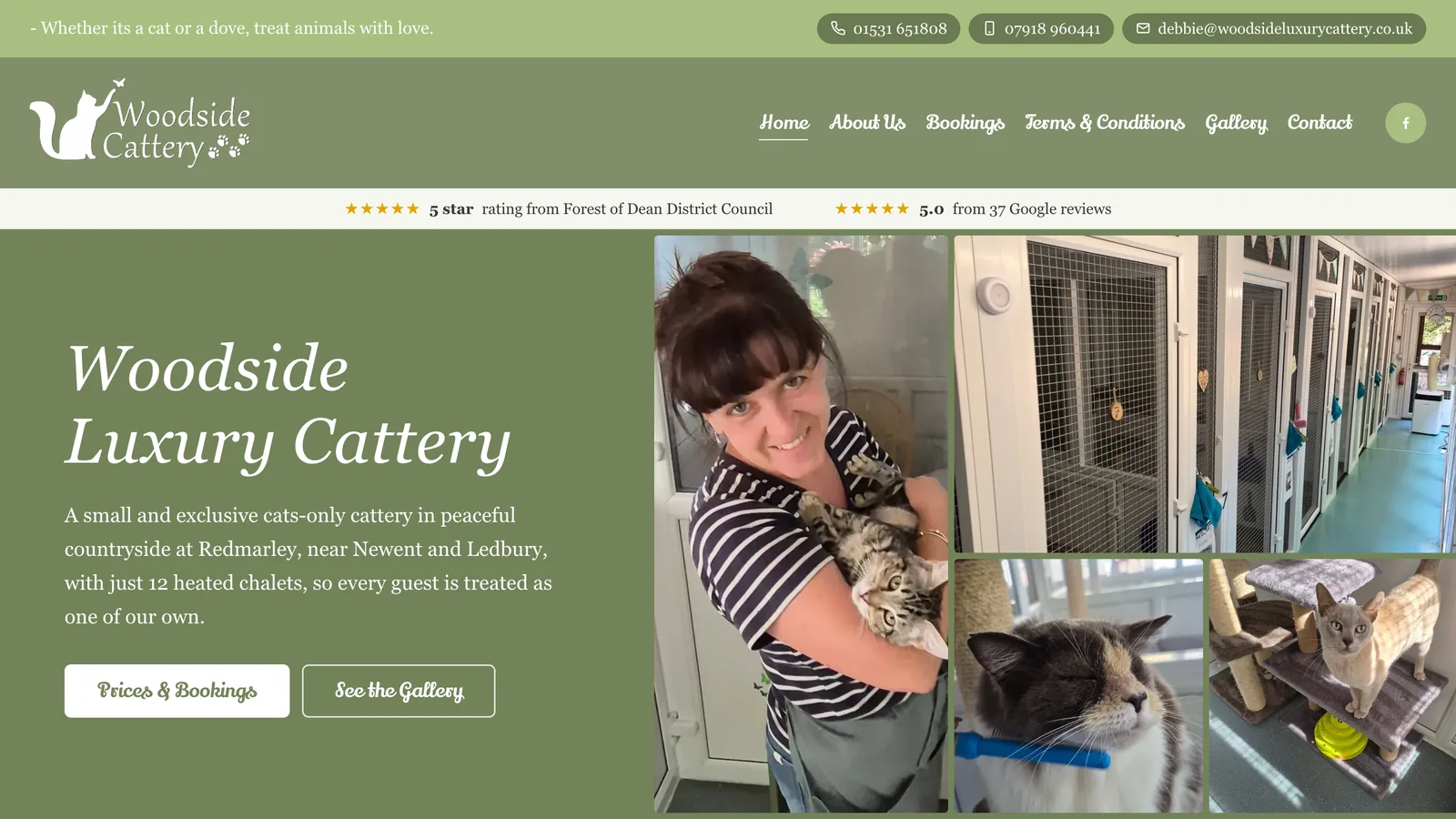
Pet owners are the same whether they're booking a walk, a groom or a week's stay. Woodside Luxury Cattery, near Newent and Ledbury, puts its council licence, 5 star rating and Google reviews where people can see them, along with plenty of photos of where the cats stay.
Case study
Woodside Luxury Cattery, Redmarley, near Newent and Ledbury
woodsideluxurycattery.co.uk (opens in a new tab)A small licensed cattery that wanted to leave Squarespace without changing a website its customers knew. We kept the design, words and photos, rebuilt it to be far faster on a phone, and put its council rating and Google reviews up front.
Read the case study- same design, now faster and easier to find
- Fully rebuiltsame design, now faster and easier to find
- Google speed score on a phone, up from 78
- 99/100Google speed score on a phone, up from 78
- from our first call
- Built in 7 daysfrom our first call
If you're still at the planning stage, we've also written about how to start a dog walking business and how to start a dog grooming business. And if you'd like the whole thing written and built for you, see our websites for pet businesses.
Rather not do it yourself?
We write it, build it and look after it, for £450 and then £15 a month. You pay nothing until you have approved the site, and it's usually live within 7 to 14 days.
See pet business websitesFrequently asked questions
Not when you are starting out, but one becomes useful once you want more customers than word of mouth brings. Most people who hear your name look you up first, and a website gives them your prices, areas and reviews in one place.
There's no set number. Most small grooming or walking businesses need a homepage, services and prices, an about page, reviews or a gallery, and a contact page. A page for each main service or area can help as you grow.
In most cases, yes, even as a guide. People search for dog walking and grooming prices all the time, and showing yours saves you answering the same message repeatedly.
No, not if you work from home or you are mobile. List the towns and villages you cover instead, and set your Google Business Profile up as a service-area business so your address stays hidden.
Website builders such as Wix or Squarespace usually cost about £110 to £300 a year plus your time. Freelancers and agencies usually cost from several hundred pounds to several thousand. Our managed service is £450 to build, then £15 a month.